Showing posts with label documenting. Show all posts

Tuesday, 17 January 2012

A bad day is a good day for something new.

We got a new camera. We got it for Yule. It arrived yesterday. Yesterday was not Yule. Yesterday was Monday.

I had a New Year Project planned, a 365 day (well 366) photo blog, but it has transformed into a 17th January project which is even better. The 17th January is known as Blue Monday* - well at least it was last year, this year Blue Monday is on the 23rd, but I can't wait that long so I will go with last years date even though it is Tuesday today - anyway, it is said to be the most depressing day of the year (I guess among countries in the Northern Hemisphere that celebrate Christmas) which to me makes it a good day for something new**.

So, I shall start. Introductions are a good start.

This Ernest who doesn't like to have his picture taken.
This is Lily who does.
This is Gábor who tolerates my photographing of him - at least for now (this is only day 1 after all).

These people will likely feature often.

It seems only fair that there should be a picture of me included here in this introduction round so...

This is me.
It's not a big picture because it wasn't taken by me or with my pretty new camera (rather it is of me with my new camera). It is also small because I don't like photos of me, I definetly have a prefered side of the camera. My face will not feature here often.

What a treat you*** have had with this first post. You got 3 (+1) photos today. From now on there will be but one photo each day (unless I change my mind).

Done.


*Blue Monday is not real, I mean it isn't really the most depressing day of the year. It was created by Sky Travel in order to sell holidats to people who believe it when someone tells them their life is crap and that you can make it better with a trip to the Canary Islands.

**Yes, I just completely made up some "just because" justification for starting today when really the reason is just that my camera arrived yesterday.

***I say you as though I am actually a bit full of myself and writing to an audience but this project is more for me but you can view/read along too if you like. You are welcome.

Tuesday, 25 October 2011

Representing Reality

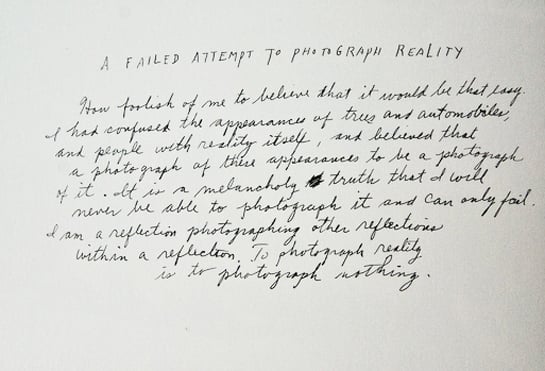
I just came back from one of the most hectic excursions I have ever been on; 4 days, 5 cities, 2 countries, 9 galleries, 2 castles, 3 churches, an artists community and a medeival settlement. I saw well over 3000 images in theses galleries, some were huge whole wall instalations. I saw Monets' , Miros', Munchs' and Picasos'. Yet of all of these, the one that stood out for me was this note (not even a photograph) by Duane Michals; no larger than a postcard.


Image courtesy of:  http://www.reframingphotography.com/content/duane-michals
(this is not the exact one that I saw but almost)
Text reads:

A FAILED ATTEMPT TO PHOTOGRAPH REALITY


How foolish of me to have believed that it would be that easy. I had confused the appearences of trees and automobiles, and people with reality itself and believed that a photograph of these appearences to be a photograph of it. It is a melancholy truth that I will never be able to photograph reality and can only fail. I am a reflection, photographing other reflections, withing a reflection. To photograph reality is to photograph nothing.

When it comes to are as research, it is true that such reserch will not depict reality; rather a reflection of a reflection. But is that realy any different from other research?


Thursday, 28 July 2011

"My mum won't understand if I write it like that"

Although I didn't keep track of Lily's language development from the beginning there are still so many things I could write about. 

  • Lily took 2 years to start speaking Finnish despite understanding most things after a couple of month in daycare (Lily can be very stubborn (I have no idea where she gets it from...I don't know anyone like that, do you?), she one told me, after I had told her it would take a lot of time and practice to learn to ride her bike, that first she will learn to do that then maybe she will learn to speak Finnish).
  • She very rarely codeswitches or borrows words from the other languages, I suspect it is to do with the fact that rather than being in a multilingual environment, she has been in multiple monolingual environments (probably also because up until last year, Gabor and I were pretty "strict" with the one person/one language thing and rarely codeswitched ourselves.).
  • One of the few multilingual settings I can think of is when she and Gabor would go to the library and Gabor would read to her in Finnish, she would ask questions about the story in English and he would answer them in Hungarian.

Just a month ago before we returned to Finland, Lily had almost completely forgotten Finnish. She hadn't had to use the language in a year and Gábor and I don't really speak well enough to encourage her to. I knew that one and a half months would probably be enough time for her to remember the language before she would start school (in Finnish), I knew it, but somehow hadn't really believed it I guess since I am utterly amazed at how quickly she picked it up again. After literally only 2 or 3 days playing with some old friends and she was chatting away almost like we had never been away (almost) - in some ways even better. In the first 3 years we lived in Finland, Lily never spoke a single word of Finnish to an adult. Not even a "Kiitos" or a "Hej hej", but now she is talking her friends’ parents and even family friends in Finnish.

When I was packing up our things for the move I came across some old pictures and cards that Lily had made. I took some picture of then because they give a really sweet example of how one language can influence another and of overcorrection. Both these are from before Lily had had any formal schooling or teaching so are completely here own writing systems.

The first is a Fathers Day picture for Gábor. The letter "f" doesn't really exist in Finnish so because of the similarities in the f and v phonemes, Lily would represent them both with "v". I tried to explain that there is a slight difference in the sounds (again, it would have been useful to have paid more attention in phonetics) and that in English "f" is used to represent the sound at the start of "fathers".
Valarste - Father's Day (November 2009).

However 6 months later, when Mothers day came around I realised there had been some misunderstanding. When I picked her up from päiväkoti (daycare) she and Jonna (her carer) handed me the card bellow. "Hyfää Äitienpäiffa". Jonna had tried to tell Lily that the correct way would be "Hyvää Äitienpäivää" with v's. Lily to ld her "no, my mum won't understand if I write it like that.".

Hyfää Äitienpäiffa - Hyvää Äitienpäivää (May 2010)
Often people’s responses to Lily’s language abilities are along the lines of “wow, that’s incredible” or “she so smart”.  And yes, I think she is incredible and smart, but I am her parent, I’m not exactly objective. The truth is Lily isn’t able to speak three languages because she is super smart; she can speak three languages because she has been exposed to tree languages and because she can recognise that there is a need for her to know all three languages in her life environment. There is also some truth to her being super smart though; there is even a connection between her intelligence and her multilingualism. It’s not that she is smart so can speak lots of languages; rather she speaks lots of languages which makes her smart.  

There are loads of cognitive benefits which go way beyond the “it will make learning other languages easier” that people take for granted. It can improve the ability to recognise patterns and structures in general; it can also improve the ability for abstract thought and creativity. Bi/multilingual children can recognise earlier that not everyone thinks alike and therefore a likely more interculturally competent and since they are aware of the differing language needs of others around them they also become more aware of the needs of others in general. So yes Lily is wonderful (perhaps I should say marvellous – it’s her favourite word at the moment), yea Lily is marvellous, but part of that marvelousness comes from being multilingual.

Marvellous

Monday, 25 July 2011

Mbukka-mbukka? (Can I have a piece of that cubumber please?)


Last semester I did a course on bilingualism which I found fascinating – not only because I am raising bi(multi)lingual children but that was a huge part of it. While doing the course I realise how useful it would have been to keep a record of Lily’s language (speech) development. I figured that here is as good a place as any to keep a record of Ernő’s not least because it will show his development in the context of the events in our lives (not that I think you are particularly interested in the details of what words Ernest says when). I am starting a bit late though since he has been using words for quite some time now.

Side note:           The main textbook for the course was :
                               Grosjean, Francois (1982) Life with Two Languages Harvard University Press
 I know it’s old but my lecturer claimed that no better, comprehensive book on the topic has be written since. Grosjean has a current academic blog with more up to date articles, since many of you have multilingual children too you might find it interesting.

What he calls/called us:

“Apa” (Hungarian for dad) was the first word he used to address both Gábor and I; I really meant “Parent or other grown up person, I need your help”. Since he was saying “Apa”, I also tried to encourage him to say “Mum”. I don’t know if he thought I was correcting him or if he just thought two different words was unnecessary, but “Mum” completely replaced “Apa”. Soon after that though he noticed that the other kids in the park called their grown up “Anya” (Hungarian for mum) so, since Gábor was the one who took him to the park most often, Gábor became “Anya”. And this is how it was for quite some time; a language destination but not a gender destination.  Gábor has recently become “Apa” again.

Since being back in Finland Ernest has pick up another word from the other children. He uses it when he is stuck in the swing or when he falls over. The word is “Aiti” (Finnish for mum).

“L” is pretty difficult to say so Lily is “Ee-ee”. Ernő likes to help us cook dinner and is pretty perceptive when it comes to knowing when the food is just about ready. He sets of to find his sister “Ee-ee! Ee-ee!” and drags her to the bathroom to wash hands. While he knows that his name is Ernest or Ernő he never really refers to himself yet, however he does say “Ernő” although he normally uses it when someone is doing something that he doesn’t like or misbehaving.

One of his first words (if not the first (I told you I should have started this earlier, I am already forgetting specifics)) was “tessék” (it’s a Hungarian word that you can use to mean “there you go” ie. when you are giving something to someone, or it can be used to mean “here you are” for example the stall holders in the market use it to call in customers). Ernest uses it when playing these games of passing items back and forth to mean “there you go” or “can I have that now?” or “thank you”. The other day though because I was responding to his handing me things with “thank you” he started to use “tes-you” with me.

“Tessék” (or tes-you) only means “can I have that?” in the context of these games though, in other circumstances he says “dub-a-day” (now is where it would be useful to have stuck with the phonetic transcription classes (if any linguist friends want to help out with this project skype me or something)), that is unless what he wants is a fruit or vegetable when he uses “mbukka-mbukka”, which we suspect stems from uborka and paprika (cucumber and pepper in Hungarian in case you couldn’t guess).

I have also recently noticed him starting to differentiate between “bye bye”, “pá pá” and “hej hej”, he hasn’t completely figured out who to use which one with and when but clearly knows they are the same/same but different.

This is of course not the full extent of his vocabulary (more an introduction) but this (I hope) will be an ongoing project.

Tessék


HELP: Does any one have access to “The International Journal of Bilingualism” from 1997? There is an article I would really like to read, “Language Contact in Bilingual Two-Year-Olds and Code-Switching: Language Encounters of a Different Kind?” ,but the subscription through Oulu University only goes back as far as 2003.


This post has been included in September's Blogging Carnival on Bilingualism, please check out the other articles on the carnival list.
Related Posts Plugin for WordPress, Blogger...